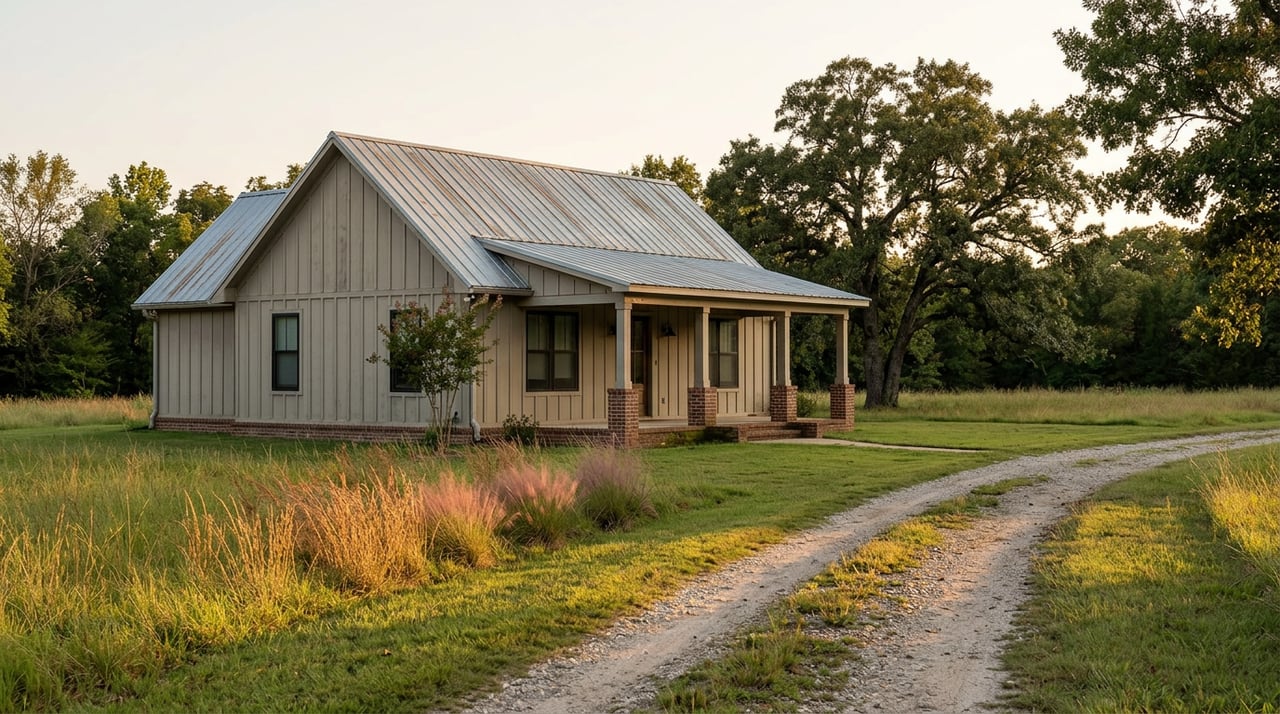
What to Know About Buying Acreage Near Oklahoma City
August 13, 2026
August 13, 2026
Two ten-acre tracts sit within a few miles of each other on the edge of Piedmont. Same size, same rough distance to town, same rolling pasture look in the photos. One lists for meaningfully more per acre than the other. A buyer comparing them on price alone will guess the higher one has better soil, a pond, maybe road frontage. Sometimes that's true. Just as often, the real difference has nothing to do with what's visible from the truck.
Acreage pricing near Oklahoma City's growing edge, Piedmont, the Canadian County corridor, the stretch of Logan County closest to Edmond, gets treated like a single number problem. Buyers pull a per-acre average, compare it to two or three listings, and pick the one that looks cheapest for the size. That approach misses three separate variables the sticker price bundles together without labeling: how many acres are in the tract, what's underneath it, and what the county assessor thinks the land is being used for. Each one moves the real cost independently of what the listing headline says.
Start with the one that catches buyers off guard hardest, because it rarely comes up until after an offer is accepted: does the price include what's under the ground.
Oklahoma is an oil and gas state first and a farm state second.
The part that surprises out-of-state buyers most is that title insurance won't bail them out. Oklahoma's title insurance industry almost universally excludes the mineral estate from coverage, a position that traces back to a 1984 opinion from the state insurance commissioner classifying mineral-related coverage as property insurance rather than title insurance. A standard Oklahoma title policy will insure that you own the surface. It will not insure that anyone can drill on it without your consent, and it will not tell you whether a check for a future oil and gas lease is going to show up in your mailbox or someone else's.
There's a second layer buyers don't expect. According to gwlawok.com, Oklahoma courts have ruled that if a deed accidentally omits a mineral reservation the seller intended to keep, the seller has five years from the date the deed is recorded to go to court and fix it. In one case that made its way through the Oklahoma Supreme Court, two sisters who intended to sell only the surface of their land discovered years later that a title company's clerical error had conveyed their minerals along with it, and by the time they found out, the five-year clock had already run out. The buyers kept the minerals.
None of this means acreage near Piedmont or Edmond's edge is a bad buy. It means the mineral question belongs in due diligence, not as an afterthought. A title search that traces the chain of ownership back through prior deeds costs far less than discovering after closing that the tract you thought came with full ownership was surface only.
Here's the part that runs against how most buyers expect land pricing to work. Bigger purchases are supposed to come with volume pricing. A 120-acre tract should, in theory, cost less per acre than a 10-acre tract, the same way a case of anything is cheaper per unit than buying one at a time.
Rural Oklahoma land frequently does the opposite. Smaller tracts in the 5 to 20 acre range often sell for a higher price per acre than large working ranches, because far more buyers can afford the total purchase price of a 10-acre homesite than can write a check for a 300-acre operation. The buyer pool for a small tract close to a growing city includes commuters, retirees, and anyone wanting a country feel without the working-ranch commitment. The buyer pool for a large tract narrows to operators, investors, and a handful of legacy ranching families. More competition for the small end of the market bids the per-acre price up even as the total check size stays manageable.
You can see the shape of this in the active Canadian County market. Listings recently on the market range from a 120-plus acre undeveloped farmland tract just outside Piedmont's city limits down to much smaller parcels elsewhere in the county, including a roughly 9-acre tract in eastern Canadian County near Gregory Road and a 35-acre ranchette positioned between Yukon, Oklahoma City, and El Reno with frontage close to NW Expressway and Highway 3. The large farmland tract and the small, utility-ready parcels aren't competing for the same buyer, and they don't price on the same logic. One is valued on agricultural income potential. The other is valued on how close it sits to a paved road, electric service, and a commute.
Statewide, the direction of travel supports why proximity matters so much. Oklahoma farm real estate averaged $2,880 per acre in 2025, up 5.9 percent from the year before, according to the USDA's National Agricultural Statistics Service Land Values Summary. Pastureland alone came in at $2,260 per acre, up 4.6 percent. Those are broad state averages across all 77 counties, everything from Panhandle wheat ground to timbered acreage in the southeast, and they say almost nothing about what a specific 10-acre tract two miles from a growing suburb is worth. A separate quarterly tracker covering Oklahoma land sales from the third quarter of 2023 through the second quarter of 2026 put the statewide average closer to $2,790 per acre, with prices climbing roughly $109 per quarter over that stretch, and Q2 2026 recorded as the busiest quarter in the entire three-year window at 224 sales. The trend line is up. What any individual tract does within that trend depends far more on its size class and its distance from the metro edge than on the county average.
The third number hiding inside the sticker price shows up after closing, on the tax bill, and it depends entirely on what the buyer does with the land rather than what the land looks like.
According to Landmodo, Oklahoma allows land used for legitimate agricultural purposes, cattle grazing, hay production, farming, timber management, to be assessed at its agricultural valuation rather than its full market value. The difference is not small. Land taxed at agricultural valuation can run well under $10 per acre per year in many counties, while the same acreage assessed at market value carries a meaningfully higher bill. Filing for the exemption requires submitting Form OTC 994 to the county assessor, and the deadline is March 15.
This is why two visually identical 10-acre tracts near Piedmont, both with a pond and a fence line, can carry very different annual holding costs. One owner runs a few head of cattle or bales hay and files the paperwork on time. The other treats the land as a homesite with a big yard and never files, because the property doesn't function as an agricultural operation. Nothing about the market price makes this obvious, and it rarely gets discussed until a buyer's first tax bill lands.
None of these three mechanisms show up as a line item on a listing sheet. Growth pressure on the Canadian County side of the metro is real and recent: the county approved every one of the 40 land-use decisions it made through late July 2026 out of 38 total projects, with Piedmont ranking as the second-busiest city for new activity behind only El Reno. That kind of approval rate signals a market where proximity to development keeps pulling acreage prices upward, which makes the size, mineral, and tax variables matter even more, not less, because the stakes of guessing wrong on any one of them go up as land near the edge of the metro gets scarcer.
A buyer comparing two tracts should ask three questions before comparing per-acre price at all: how many acres, in what size class, is this actually competing against; does the deed convey the minerals or only the surface; and is the land currently qualified for agricultural valuation.
Can I get title insurance that covers mineral disputes in Oklahoma? Standard Oklahoma title policies almost universally carve out the mineral estate from coverage. Buyers concerned about subsurface activity typically need to investigate mineral ownership separately rather than relying on the title policy.
If I buy land without the agricultural exemption, can I apply for it later? Yes, but the filing deadline is March 15, and the land has to actually be used for a qualifying agricultural purpose, not just zoned as rural.
If you're comparing acreage near Piedmont, the Canadian County corridor, or the edge of Edmond and want someone to walk the mineral history, the tract size logic, and the tax picture with you before you write an offer, Access Real Estate works with buyers across Greater Oklahoma City on exactly this kind of property. Work With Us.
This article is general information, not legal, tax or financial advice. Consult a qualified professional about your situation.
Stay up to date on the latest real estate trends.
Give us a call when you are ready to make a move. We would be honored to assist with any and all of your Oklahoma Real Estate needs.